On the American Journal of Fashion — its purpose, its people, and what we intend to build.
Fashion has always had narrators. Editors, critics, stylists, buyers — a chorus of voices that shaped how the world understood what designers were making, and why. For most of the industry’s history, the designer spoke through the garment. Someone else did the explaining.
The American Journal of Fashion exists because we believe that arrangement is incomplete. Not wrong — that tradition has real depth, and we have no interest in dismantling it — but incomplete. The people who make fashion should also be the people writing about it, with equal standing and genuine space. This journal is that space.
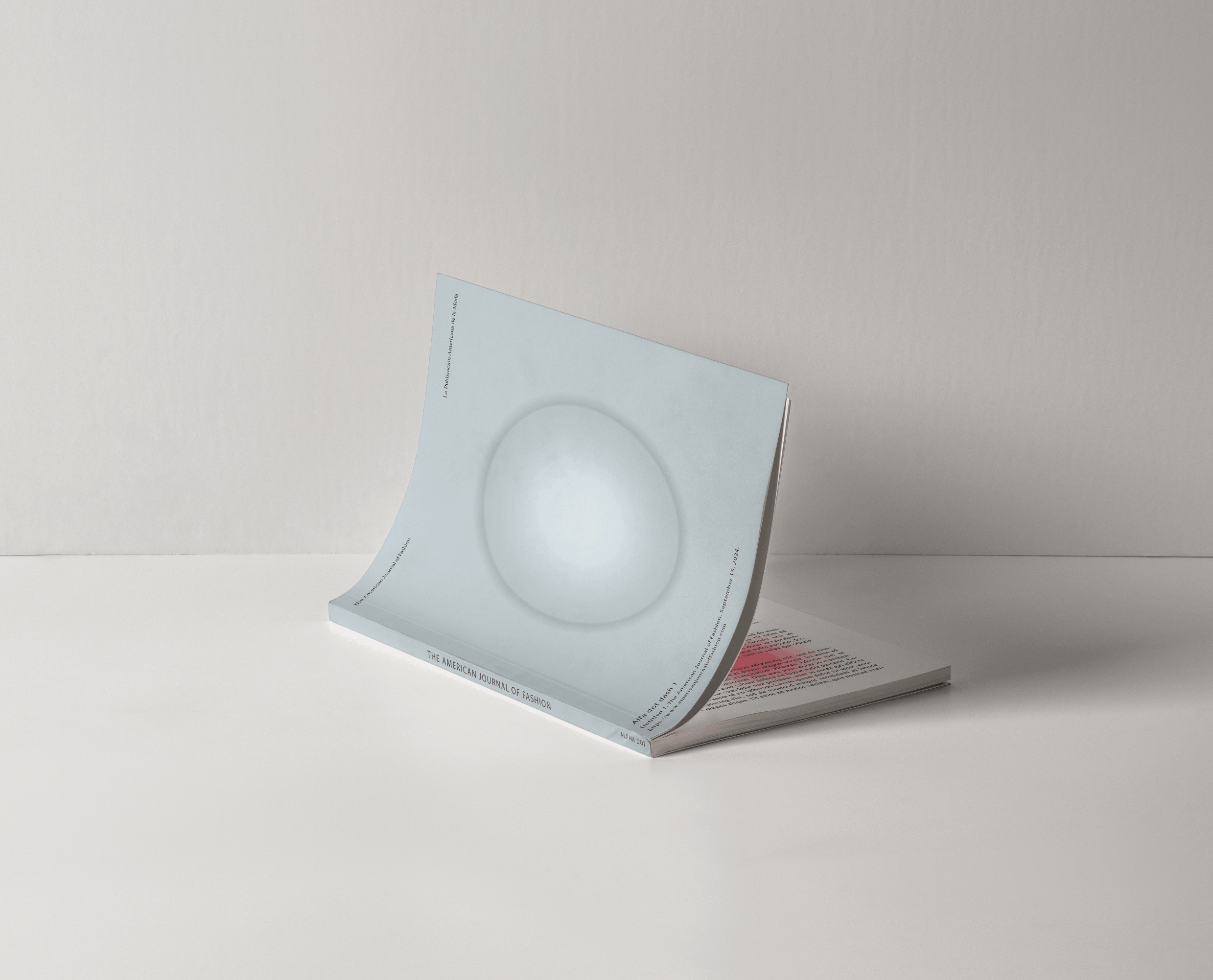
At its core, AJF is a tool. That word is intentional. A tool is useful, practical, and in the hands of the person doing the work. The American Journal of Fashion is a publication built to be useful to fashion professionals and designers — not a vehicle for outside commentary on them, but a platform they own and shape.
The journal is submission-based, which means anyone in the industry can submit work to be published. That word “anyone” is generous on purpose. It means the independent designer and the established label, the student and the veteran, the maker and the theorist. If you work in fashion and you have something to say, there is a place here for you.
The content we publish is deliberately wide. Long-form research papers and collection defense essays — documents that walk through a design process with care, citing sources, explaining concepts, showing the intellectual architecture behind the work. Opinion pieces and editorials. International submissions and perspectives. And personal creative work: the full creative life of people whose professional lives happen to be in fashion. More on that below.
Geographically, AJF is rooted in the Americas — North and South — and welcomes international voices with meaningful input about this hemisphere. Fashion here is not a monolith. It carries specific histories, contradictions, and innovations across an enormous and diverse part of the world, and the journal should reflect that range.
There is a version of what we are describing that sounds, on paper, like it has had all the fun removed from it. Citation requirements. Written theses. Documentation standards. It can start to sound less like fashion and more like a graduate seminar.
That is not what we are building, and it is worth being direct about that.
Fashion is, at its core, one of the most party centric industries. It is about desire and beauty and self-expression and the electric feeling of wearing something exactly right. It has always been inseparable from culture at its most alive — from music, from nightlife, from the street, from the body in motion. The most enduring designers in history were not only rigorous thinkers. They were also, simply, cool. Philo, MNZ, Lemaire, Wales Bonner... The ideas and the appeal were never in opposition. They fed each other.
AJF holds both. We believe that a designer who can articulate why a silhouette works is not less fashionable for it — they are more so. Depth and desirability are not opposites. A collection that carries a fully realized intellectual framework and also makes you want to wear it immediately is not a contradiction. It is the goal. Writing is hot. Reading is cool.
So while we are serious about documentation, attribution, and the written record, we are equally serious about staying connected to what fashion actually is and does in the world. We want to publish work that is rigorous and seductive. Researched and beautiful. Argued and felt. The journal should feel like something you want to read, not something you have to. And the work it publishes should reflect the full spectrum of what fashion can be — from the theoretical to the purely, unapologetically gorgeous.
One of the quieter but most consequential things AJF does is keep a record. Every work published in the journal — provided it meets the basic standards for submission — is indexed and archived. That means it exists. Not just in the moment of publication, but persistently, accessibly, as part of a growing body of documented fashion thought originating from the Americas.
This matters more than it might first appear. Fashion has a memory problem. Collections are shown, reviewed, and forgotten. Designers build entire bodies of work that leave almost no written trace. The intellectual labor that went into a decade of collections can disappear entirely when a label closes or a career shifts. AJF is building the archive that the field has never had — a permanent, searchable index of design thinking, creative work, and professional insight from the people actually making fashion.
For the designer, this means something practical: your work, once published, has a home. It can be cited. It can be found by a student researching a tradition you contributed to, by a curator building an exhibition, by a journalist tracing the history of an idea. It becomes part of the record. That is not a small thing. For most of fashion history, that kind of permanence has been reserved for the brands with institutional backing and the designers with dedicated archivists. AJF extends it to everyone who meets the standard and submits.
The standard itself is not punishing — it is intentional. We ask that submissions are original, that sources are cited where relevant, and that the work represents a genuine contribution to the journal’s areas of focus. Meet those bars, and your work is in. Indexed. Archived. Permanent.
The most urgent work AJF is doing is building a culture of articulation in fashion design. This is the thing that motivated the journal’s founding, and it is worth explaining carefully.
When a designer completes a collection, a tremendous amount of intellectual and creative labor goes into it. Sources were consulted. Images were studied and chosen. Techniques were adapted, sometimes from designers who came before, sometimes from communities with deep histories in a particular craft. A philosophical thread runs through the garments. And then — in most cases — that context disappears. It lives in sketchbooks and studio conversations, and rarely makes it into the public record.
We think this is a problem worth solving. Not because we want to impose academic methods on a creative field, but because the practice of articulation has real benefits — for the designer, for the reader, and for the field as a whole. Designers who engage carefully with the past perpetuate important work through credit and attribution. They build on what came before, and in return, they build the future.
There is something that happens when a designer sits down to write seriously about their work. The act of writing — of constructing an argument, following a reference to its source, reading a paper and disagreeing with it, tracing an idea backward through history — is not merely documentation. It is thinking. And that thinking feeds back into the work itself. A designer who has spent time genuinely researching the structural philosophy behind a silhouette, or the cultural history of a textile, or the theoretical writing of a designer they admire, brings that depth into the studio. The collection that results is richer for it — more considered, more layered, more aware of its own place in a longer conversation. Writing is not a record of design thinking. It is part of design thinking. AJF exists, in part, to give designers a reason and a format to do that work.
There is also a specific ethical dimension here that matters to us. Giving credit — citing the image that inspired a silhouette, acknowledging the indigenous textile tradition behind a pattern, naming the designer whose work you are in dialogue with — is not merely a formality. It is an act of integrity. It is the right thing to do, and it is currently under-practiced in fashion. AJF wants to change that, one published body of work at a time.
Fashion attracts extraordinarily creative people. That is not a controversial claim. But what is less often said is that those people — the designers, the patternmakers, the stylists, the photographers, the buyers, the educators — are not only creative within fashion. They paint. They write poems. They make furniture. They build homes and take photographs and compose music and tend gardens. Their creative lives extend far beyond the garment, and those lives are inseparable from the work they make.
AJF is one of the only publications explicitly dedicated to showing that fuller picture. We actively seek and publish work by fashion and design professionals that has nothing to do with fashion at all. A poem written on a train between shows. A series of paintings made over a decade in the margins of a design career. A photo essay about a neighborhood. A short story. A drawing made for no reason except that it needed to be made.
This matters for several reasons. First, it tells a truer story about who the fashion community actually is — not a collection of specialists, but a group of whole human beings whose work in fashion is one expression of a much larger creative intelligence. Second, it creates a more interesting and honest publication. The relationship between what a designer makes professionally and what they make personally is rarely clean or separable. Showing both gives readers a richer understanding of each.
A useful example: Rick Owens and his furniture. That body of work is not fashion, but it is completely inseparable from how Owens thinks about form, material, and the body. Publishing that kind of work — the creative production that lives alongside and beneath the collection — is something AJF is built to do, and that very few other publications have any interest in. We think that is a gap worth filling.
So if you are a designer who also writes poems, submit the poems. If you are a stylist who paints, submit the paintings. If you are a patternmaker who photographs the landscapes you drive through on the weekends, submit the photographs. This journal is yours, and it is interested in all of you.
In many design fields, journals are abundant. Architecture alone has dozens: publications dedicated to design philosophy, specific aesthetics, peer-reviewed practice, history, and theory. You can spend a lifetime reading architectural discourse and still not reach the edges of it.
Fashion has almost none of that. Trade journals exist. Textile journals exist. But a design journal — one oriented toward the designer, toward the process, toward the intellectual and creative life of the people making fashion — essentially does not exist yet. AJF is pioneering that space. That is both an enormous opportunity and a real responsibility.
AJF is not a non-profit. We intend to build a business, to generate revenue, and to grow into an organization that can sustain itself and the people who work within it. But the way we intend to make money matters to us as much as the fact of making it. We believe that every resource the journal gains should be returned in equal or greater value to the people who contributed it. If a designer submits their work and we publish it, what they receive back — visibility, community, documentation, standing — should be worth more than what they gave us.
We also practice what we ask of our contributors. We cite our sources. The tools and references we’ve used to construct the journal’s vision are documented. If we are asking the fashion community to embrace transparency and attribution, we have to lead by example.
The journal is also committed to sustainability — not as a marketing position, but as a foundational orientation. That means being thoughtful about the paper and ink used in print, the energy used to run our servers, the carbon footprint of distribution. It means that advertising in AJF will only be offered to brands and businesses whose work genuinely benefits our readers. No one gets taken advantage of. Everyone benefits, or the arrangement doesn’t happen.
The journal has concrete ambitions. Four issues per year, in print and online. A functioning archive. Institutional relationships with university libraries and fashion design programs. Workshops that teach designers why writing about their process matters and how to do it well. A resource library — curated, cited, and expanded through a bi-monthly newsletter — that the community can actually use.
Further out, we are working toward fashion design residencies and fellowships. A network that highlights concept stores and boutiques across the country that support independent designers. White papers that explore the big questions the journal cares about — starting with the most fundamental: that fashion is not merely something to buy and discard, but a layer of the material world with depth, history, and consequence.
We want the printed journal itself to be an object worth keeping — an experimental artifact that explores what a physical publication can be, using materials and forms that push against the expected. We want the journal’s office, when we have one, to reflect the same values: low energy, open source, a place that gives back to the neighborhood and community around it.
And eventually, we intend to move toward a peer-review model, or something that meaningfully approximates it. Not because we want to import academic bureaucracy into a creative field, but because rigorous review, done well, makes the work better and the community stronger.
We want a world in which a designer’s written account of their collection carries the same weight as a critic’s review. A world in which the intellectual labor of making fashion is documented, valued, and built upon. A world in which independent designers — people working without institutional infrastructure or press relationships — have a real platform for the ideas that drive their practice.
The tool of publication has historically belonged to other people. Editors, publishers, critics — people adjacent to the work, narrating it from the outside. We are putting that tool into the hands of the community that actually makes the work. That is the premise of this journal. That is why it exists.
The journal will be molded continuously until it has found its foundation — and then keep growing from there, helping designers for generations.
We hope you will join us in contributing to the past, present, and future of fashion. A poem, a drawing, a collection thesis, an illustration.
americanjournaloffashion.com